Just over a year ago, I was mindlessly scrolling Twitter when I saw this
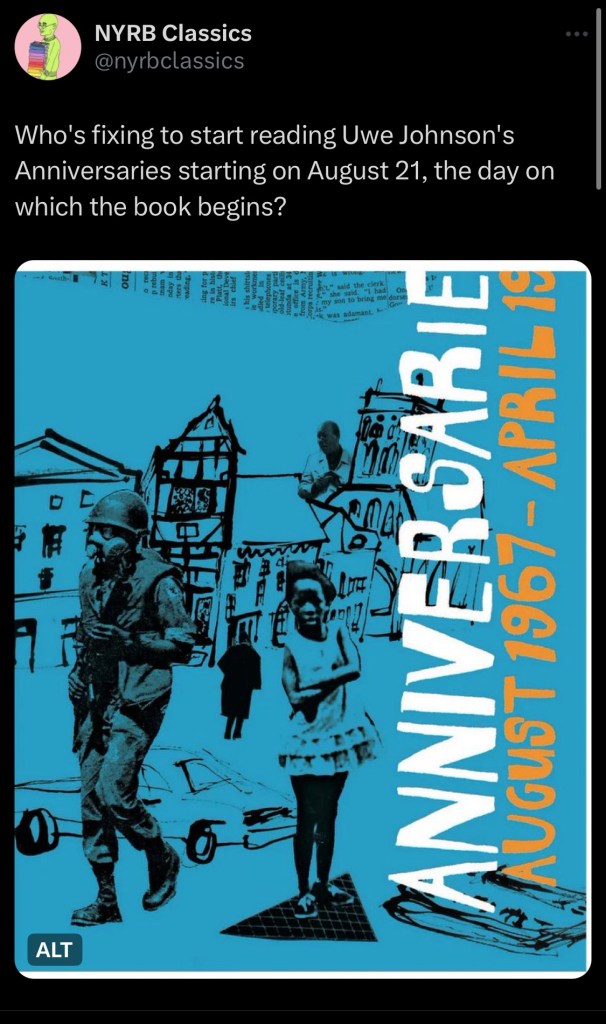
I had done something similar before, reading each of the letters in Richardson’s Clarissa on the day it was written, and I loved the new understanding it gave me of the text in time — a totally different sense of its rhythm and pacing. And a copy of Anniversaries had been sitting on my to-read shelf for awhile (like, many years). So I went for it. And it was incredible, and the absolute best way to experience this book. To do it this year, with all of its uncanny similarities to 1968, was especially perfect.
Anniversaries is the diary of Gesine Crespahl, a thirty-something year-old woman from East Germany who lives in New York City with her ten-year-old daughter Marie. Large swaths of the book are actually the stories of Gesine’s parents and their experiences of the rise of fascism, the Second World War, and life under Communism, which Gesine relates to Marie, who offers minimal commentary. But of course, the events of 1968 creep in as well.
I felt the zeitgeist of 1968 in the present most keenly in May, when protests were erupting all over colleges campuses. This was from May 1, for example:
—Today’s the 5th afternoon! Even you should know that, from your newspaper. Your aunt [KB: aka, the NYTimes] must have told you something.
—She didn’t say anything about a foreign child running around Columbia with the policemen and students.
—Not running. I stood there and watched, like other people. To make sure the police wouldn’t start beating people when they started arresting them.
—Then they’ll beat them in their paddy wagons.
—You really are a spoilsport, Gesine.
—But at least the students saw that a girl was watching, and that she agreed with them.
—It’s not much, I admit it. But maybe I’m learning how to do it.
But more broadly, reading along with the book in time allowed one to really feel just how close together the various assassinations of the period were, and thus to better imagine how terrifyingly turbulent it must have felt, and overwhelming. 2024, with its own attempted assassination, followed by the resignation of a major candidate and a surge of energy towards a new one, does give ’68 a run for its money, but we also live in a different world now, in so many ways. Or so it seems. Whenever I try to describe that difference, I start second-guessing myself. And it’s this recursive sense of time, and the thick atmospheric descriptions of the different lifeworlds (the 1930s, the 1940s, the 1950s, the 1960s!), which seems so separate from each other, but somehow all astonishingly belong to human experience of the last 100 years, that makes this book so mindblowing.
But it’s also powerful feeling of intimacy with the characters. They are so fully realized, in all these minor, mundane details. I have always been sort of flummoxed when my partner has said that he wants to know what the characters in a book or movie went on to do, after the ending — it’s just not a question I ask. But with this book, I felt an intense longing to know, to hear about what they thought of the 80s, what Marie grew up to do, how Gesine felt watching her become an adult, etc. My heart ached for them in their hardships, and was delighted by their joys. Even though I only spent maybe 10 minutes a day with them.
I’ve been really interested in ‘big books’ lately and what makes them so big; what it is, qualitatively, on any given page or two, that seems so fundamentally different from shorter books. Because it’s not just that big books have more of the same — often, they offer a fundamentally different reading experience. But what I’m finding is that every ‘big book’ seems to do so in a different way.
Of course, a diary is its own particular form, but still, this one seems different. Though also a diary, for example, Anniversaries is very different from Pawilon małych ssaków (which I loved). Partly, probably, because it does have these long narratives within (the stories of Gesine’s family, the town, etc). This might seem like an artificial element, these long stories recounted within, but I think sometimes life does spool out that way. I, for example, have a vivid memory of a week or so when I was a teenager and my dad was traveling for some reason, so my mom and I went on these long walks with our dog in the evening. I rode on my roller blades and she walked, and I asked her, I think, about her memories of life under Communism, and really just to explained to me what Communism was, and it was this one long conversation broken up over several days — I would think about what she had said all day, and store up questions to ask, and look forward to the evening, and the continuation of the story. It was wonderful.
Anyways, if I had the time, it would be great fun to read a bunch of diaries all together and think (and write?) about the differences between them. But who has the time?
Well, but we do — we find it somehow, or make it. Reading Anniversaries, for example, was certainly a large undertaking, much bigger than I’d really realized when I jumped into it, and one that had long seemed far too big, when it was 2 fat volumes staring down at me from the shelf. But what a fantastic experience. I’m so glad that I did it.
 Kasia Reads
One thought on “Anniversaries, by Uwe Johnson, tr. Damion Searls”