To get your very own copy, click here!
Winner of the Donald Murphy Prize for Distinguished First Book from the American Conference for Irish Studies and the Wacław Lednicki Award in the Humanities from the Polish Institute of Arts and Sciences in America!
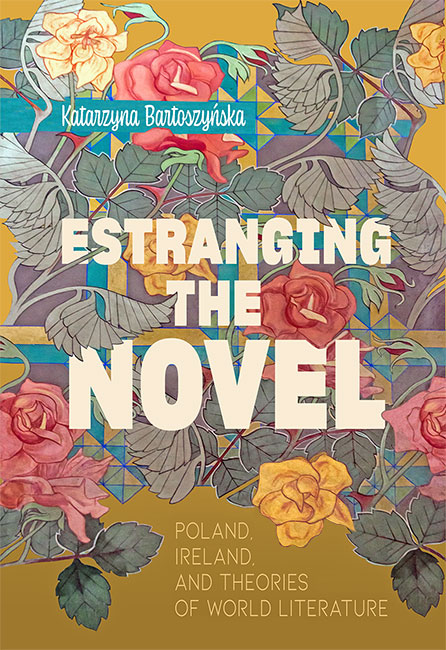
My book argues that understanding the novel in global terms means letting go of the standard Rise of the Novel narrative, and surrendering the two dominant ideas associated with the novel’s development: first, that it is the story of the emergence of realism, and second, that it was an Anglo-French phenomenon. I argue that this realist paradigm has skewed our understanding of fiction, especially fiction from “other” parts of the world, by measuring it against a false standard, and thereby failing to engage and appreciate its more interesting and innovative features. I offer a series of close readings of Polish and Irish novels as evidence, demonstrating how aspects that have been seen as “anomalous”, deviations from the novel form’s proper teleology, can instead be read as fascinating inquiries into the workings of fictionality.
A brief piece on the process of writing the book, and figuring out how to frame its main argument, can be found here.
Reviews:
Kasia Szymanska writes that it:
comprises a series of elegant close readings… uses an impressively wide-ranging analytic toolkit…Not only does her book estrange the idea of the novel, but it also makes us think about the ruts we are stuck in when approaching literary works from different traditions.
Daniel Dewispelare writes that:
the close readings are clearly written by a scholar who loves the capacities of fiction in all their complexity. As a scholar and reader, for me this book’s biggest payoff was its sustained discussion of worlding—specifically, via Eric Hayot, of the ways that occluded complexities of fiction bring new possibilities of thought into being. Though Bartoszyńska’s is a work of argumentative nonfiction, that too worlds. One can no longer think of the history of the novel more generally without taking account of the contributions of the Irish and Polish traditions. So too, one cannot think the history of the novel more generally without the contributions of all those fictional forms embedded within it from traditions yet unacknowledged.
Liam Lanigan writes that:
The wider implication of the analysis in Estranging the Novel is that we need an account of novels which are ‘anomalous or strange’ that considers their strangeness on its own terms rather than how it accords with or departs from a single history of the novel (p. 126). As Bartoszyńska notes, this requires us not just to look at novels from peripheral literary traditions, but to attend to ones that are not ‘particularly influential’, because it is in these that we are presented with a more capacious understanding of what novels can do. Estranging the Novel provides a compelling call for a new way of thinking about the novel’s history and form, and the role of peripheral literatures within it.
Bartoszyńska successfully expands the horizon of comparative literary studies and of theories of fictions more generally. Provoking and invigorating, Estranging the Novel attests to the intellectual excitement available outside the English canon and the rewards of critical encounters beyond the pale.
Bartoszyńska’s principle and method of estranging togetherness applies to eighteenth-century studies as much as it does to theories of the novel. It makes sense in our nebulous discipline (“It’s the eighteenth century, baby, and we’re still living in it,” as Joseph Roach used to say) to try out unlikely pairs or triads or constellations of distant centers.
Concluding the book by questioning the impulse toward mastery as she proposes a “weak theory” of the novel, Bartoszyńska emphasizes what the experience of reading the book has already taught: there will always be more novels to read, more forms to attend to, more languages to learn, more connections and distinctions to draw. The point, then, is not Bartoszyńska’s own masterful readings of novelistic forms — although they are a delight to read — but rather the possibilities such readings open up, the sense that they are just the beginning for new theories of the novel, new accounts of world literature, and new methods of study.
The individual analytic threads lead to certain interesting considerations that, like an open horizon or an image multiplied when reflected by several mirrors, lead even further and deeper.
Bartoszyńska’s project boldly renounces both the telos of realism and the search for sociohistorical patterns in its discussion of novels. Instead, the author commits herself to the centrifugal forces of these novels’ experiments, not readily subsumable under any towering, systematic theory.
 Kasia Reads